

Is red light therapy good for dogs? The responsible answer is that photobiomodulation may support selected veterinary rehabilitation and wellness applications, but the evidence is not equally strong for every condition, device or treatment protocol.
Red and near-infrared light have been studied in dogs for applications involving mobility, musculoskeletal comfort, wound management and postoperative rehabilitation. However, veterinary studies use different wavelengths, power levels, doses and delivery systems. Some report positive outcomes, while others report limited or statistically insignificant differences.
This guide is written for veterinary clinic owners, canine rehabilitation professionals, animal wellness operators, working-dog organizations, equipment distributors and OEM buyers. It explains the evidence, limitations and equipment questions that matter when evaluating photobiomodulation for a professional animal-care setting.
It is not a home-treatment protocol and does not replace an examination, diagnosis or treatment plan from a licensed veterinarian.
Contents
- The short answer
- What photobiomodulation is
- What the research shows
- LED red light versus veterinary laser
- How fur affects light delivery
- Wavelengths and treatment parameters
- Safety and veterinary supervision
- Equipment selection for clinics
- Workflow and cleaning considerations
- Frequently asked questions
The Short Answer: Is Red Light Therapy Good for Dogs?
Red light therapy may be useful as an adjunctive modality for some dogs when it is selected and administered by a qualified veterinary professional. It should not be presented as a cure, a replacement for veterinary care or a universally effective treatment.
Whether it is appropriate depends on several factors:
- The dog’s diagnosis and general health
- The target tissue and treatment objective
- The type of light-delivery device
- Wavelength, irradiance, dose and exposure time
- Treatment distance and coverage area
- Coat length, density and color
- Operator training and positioning
- Concurrent medication and rehabilitation
Key point: A dog standing near a red lamp is not automatically receiving a meaningful or appropriate photobiomodulation dose. Light output, tissue exposure and treatment parameters all matter.
What Is Photobiomodulation for Dogs?
Photobiomodulation, commonly abbreviated as PBM, uses selected wavelengths of visible red or near-infrared light to interact with biological tissue. The term can include LED systems and laser-based devices, although those technologies do not necessarily deliver light in the same way.
PBM is intended to produce photochemical rather than primarily thermal effects. Proposed mechanisms involve light-sensitive cellular processes and changes in mitochondrial and redox signaling. The clinical response, however, depends on more than the presence of red light.
According to the Merck Veterinary Manual’s review of photomedicine in veterinary patients , wavelength, power, dose, pulse settings, treatment technique and the ability of light to reach the intended tissue can all influence the response.
For commercial buyers, this means a high LED count or a visually bright device is not enough to establish suitability for a veterinary application.
What Does Current Veterinary Research Actually Show?
Veterinary photobiomodulation research is developing, but it remains heterogeneous. Researchers have studied PBM in dogs for musculoskeletal conditions, rehabilitation, postoperative care, wounds and selected dermatological applications. The results cannot be generalized to every dog or every red light device.
A systematic literature review of laser and light therapy in veterinary medicine identified 45 eligible studies, including 24 involving dogs. It found some positive results but also substantial variation in study quality, wavelengths, doses and treatment protocols. The authors concluded that evidence was conflicting or insufficient for many applications.
A separate review of therapeutic laser and photobiomodulation literature reported that PBM is becoming more common in veterinary rehabilitation, sports medicine and general practice, while emphasizing that evidence is stronger for some uses and mixed or limited for others.
Individual studies also show why claims need to be specific. A randomized trial involving dogs undergoing TPLO surgery found no statistically significant differences between the PBM and control groups for its principal outcome measures, although some observations were considered potentially promising.
The appropriate conclusion is not that PBM never works or that it always works. It is that:
- Some veterinary applications have encouraging evidence
- Results vary between studies
- Protocols are not interchangeable
- Device specifications affect the delivered dose
- More high-quality and standardized research is needed
LED Red Light Therapy and Veterinary Laser Therapy Are Not Identical
One of the most important distinctions for clinics and equipment buyers is the difference between a broad-area LED system and a veterinary laser.
Both technologies may fall under the general PBM category, but they can differ in optical characteristics, power density, beam delivery, treatment area, operating technique and thermal risk. Evidence generated with one device type should not automatically be used to support another.
| Factor | Broad-Area LED System | Veterinary Laser System |
|---|---|---|
| Coverage | Can illuminate a larger area at one time | Often provides more localized delivery |
| Application | May support broad-area wellness or rehabilitation workflows | Frequently used for targeted professional applications |
| Positioning | Distance and orientation strongly influence irradiance | May use contact, scanning or point-by-point techniques |
| Operation | Requires a defined distance, time and positioning procedure | Typically requires trained professional operation |
| Evidence | Laser study results cannot automatically validate an LED system | Results remain specific to the tested laser and protocol |
Clinics should request the actual wavelength, measured irradiance at the intended distance, treatment area, timer range, pulse options and dose calculation method. Labels such as “professional,” “clinical grade” or “high power” do not replace measurable specifications.
How Fur, Coat Color and Positioning Affect Light Delivery
A major difference between human and canine PBM is the presence of fur. A dog’s coat can reflect, scatter or absorb part of the emitted light before it reaches the skin. The amount reaching the target tissue may vary with:
- Coat length and density
- Coat and skin pigmentation
- Whether the hair is parted
- Distance between the device and the dog
- Angle of the light source
- Movement during the session
- Whether direct contact is appropriate for that device
This is why an irradiance value measured directly at the device surface may not represent the energy reaching a dog’s skin or deeper tissue in actual use.
A professional clinic should not compensate for fur by arbitrarily increasing session time or intensity. Higher exposure is not automatically better, and photobiomodulation may exhibit a biphasic dose response in which an excessive dose does not necessarily produce a stronger benefit.
Any animal-specific protocol should be established by an appropriately qualified veterinary professional using the specifications of the actual device.
Which Wavelengths Are Used in Canine Photobiomodulation?
Veterinary PBM studies have used different visible red and near-infrared wavelengths. Red wavelengths are generally absorbed more strongly in superficial tissues, while selected near-infrared wavelengths may travel farther through tissue under appropriate conditions.
However, wavelength alone does not determine treatment suitability. A complete technical evaluation must also consider:
- Irradiance: optical power delivered per unit area
- Energy dose: irradiance multiplied by exposure time
- Treatment area: the surface area receiving light
- Distance: space between the light source and the animal
- Beam angle: how the light spreads across the target area
- Continuous or pulsed output: how light is delivered over time
- Thermal behavior: whether prolonged operation creates unwanted heat
- Coat interference: how much light reaches the skin through fur
Magique Power provides information about LED selection, wavelength control and output testing on its LED Chip Technology page . These manufacturing capabilities may support customized equipment development, but they do not by themselves establish an animal-specific treatment protocol.
Potential Canine Applications Being Studied
Veterinary researchers and rehabilitation professionals have investigated PBM as an adjunct in several areas. These include:
- Mobility and musculoskeletal rehabilitation
- Osteoarthritis-related pain and movement limitations
- Postoperative rehabilitation
- Selected soft-tissue injuries
- Wound-management programs
- Selected dermatological applications
- Recovery routines for sporting and working dogs
This list describes areas of investigation and professional use. It is not a list of guaranteed indications, and it should not be used to diagnose a dog or select a treatment without veterinary evaluation.
Sudden weakness, severe pain, inability to walk, open or infected wounds and rapidly changing symptoms require timely veterinary assessment rather than unsupervised light exposure.
Safety, Eye Protection and Veterinary Supervision
PBM is often described as non-invasive, but that does not mean every device or protocol is appropriate for every dog. Safety depends on the equipment, power level, target area, session duration and the animal’s health status.
A veterinary professional should evaluate the intended use before light is applied near:
- The eyes
- A known or suspected tumor
- Active bleeding
- A pregnant animal’s abdomen
- Areas with reduced sensation
- The thyroid region
- Open growth plates in young animals
- Areas of unexplained swelling or severe pain
Eye protection should be selected according to the emitted wavelengths and device classification. Staff must prevent a dog from looking directly into an active light source. Protective equipment should fit the animal appropriately without adding distress.
The clinic should also establish a stop procedure for signs of overheating, skin irritation, anxiety, unexpected movement or discomfort. Animals should never be restrained in a way that compromises breathing or welfare merely to complete a session.
What Veterinary Clinics Should Evaluate Before Buying PBM Equipment
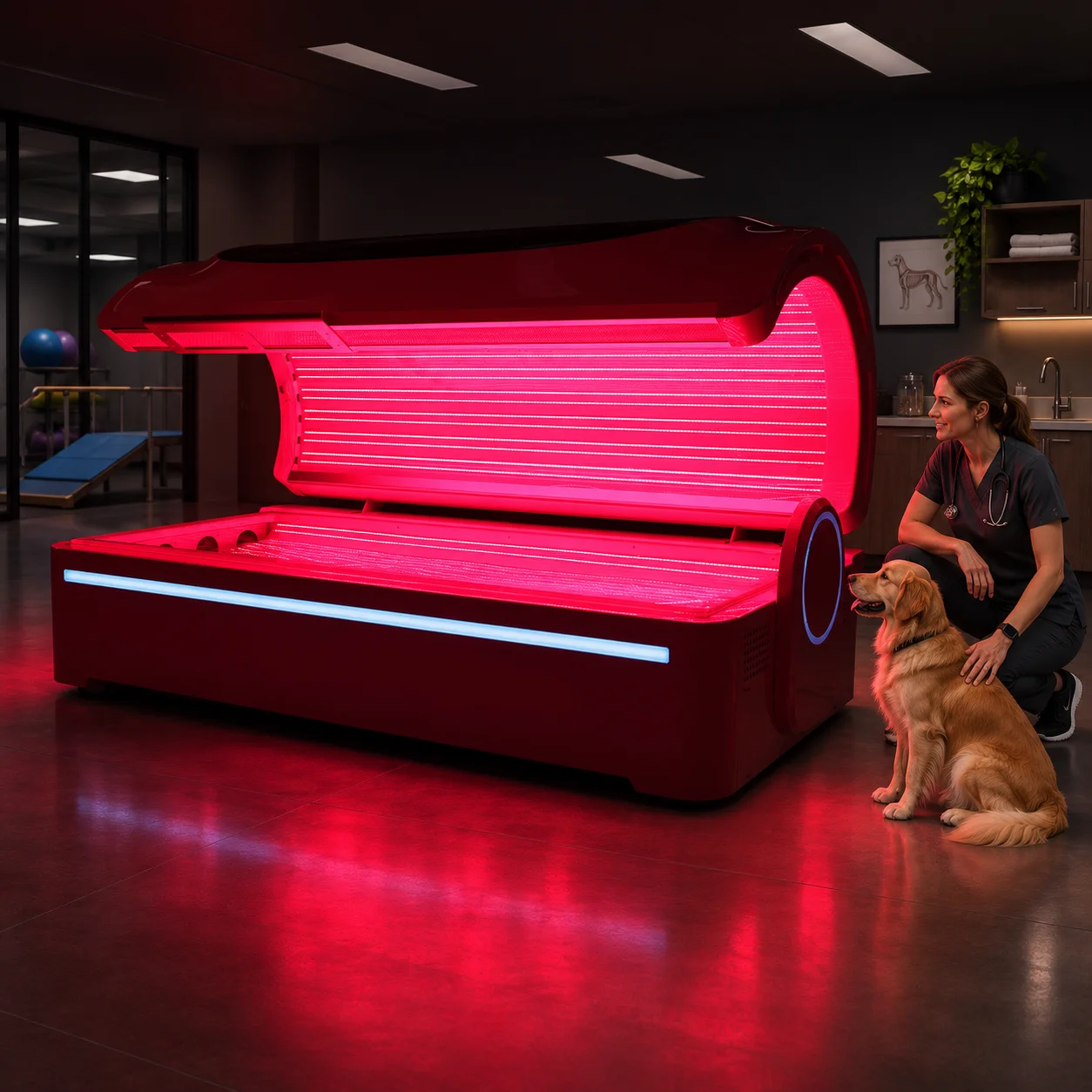
A veterinary clinic should begin with its intended workflow and patient population—not with the highest wattage or the largest number of LEDs.
Before requesting a quotation, define whether the equipment is intended for:
- Targeted joint or soft-tissue applications
- Broad-area canine rehabilitation sessions
- Working and sporting dog recovery programs
- Veterinary wellness services
- Supervised postoperative support
- Mobile or stationary clinic use
- Multi-species operation
Professional buyers should then request the following information:
| Specification | Why It Matters | What to Request |
|---|---|---|
| Wavelengths | Different wavelengths interact differently with tissue | Nominal wavelength and manufacturing tolerance |
| Irradiance | Needed to calculate the delivered energy | Measured values at relevant operating distances |
| Coverage | Affects positioning and session consistency | Illuminated area and uniformity data |
| Timer and controls | Supports repeatable staff workflows | Timer range, intensity control and lockout options |
| Thermal management | Helps limit unwanted heat during repeated sessions | Cooling design and operating-temperature limits |
| Cleaning compatibility | Important for multi-animal environments | Approved disinfectants and surface-care instructions |
| Serviceability | Reduces commercial downtime | Spare parts, warranty and technical support plan |
Magique Power manufactures commercial red light therapy beds and panels and supports customized photobiomodulation equipment projects. Buyers can review the company’s manufacturing and customization capabilities and its wholesale red light panel solutions .
Existing products should not be assumed to be veterinary medical devices. A veterinary project requires a separate evaluation of intended use, operating parameters, labeling, safety controls and market-specific requirements.
Workflow and Cleaning Considerations for Veterinary Facilities
Equipment specifications are only part of a successful veterinary PBM service. The clinic also needs a workflow that staff can follow consistently.
Patient assessment
A veterinarian should identify the target area, treatment objective, contraindications and method for monitoring progress. The clinic should record the specific device, settings, distance and duration used.
Positioning and animal comfort
The dog should be positioned comfortably and monitored throughout the session. Equipment should allow staff to maintain the intended treatment distance without forcing the animal into an unstable or stressful posture.
Repeatable operation
Timers, saved settings and clear operating instructions can reduce variation between staff members. Presets should not be treated as substitutes for veterinary judgment unless they have been developed and validated for the intended animal application.
Cleaning and infection control
Hair, saliva, urine and environmental debris can contaminate surfaces in animal-care environments. Equipment should have accessible surfaces and manufacturer-approved cleaning procedures. Strong chemicals should not be used unless compatibility with lenses, acrylics, coatings and electronic components has been confirmed.
Maintenance records
Clinics should document cleaning, inspections, faults, repairs and changes in optical performance. A device that still emits visible red light may not necessarily be delivering the same measured output as when it was new.
Questions Distributors and OEM Buyers Should Ask
- Has this configuration been designed or evaluated for veterinary use?
- What wavelengths are available, and what is their manufacturing tolerance?
- At what distance is irradiance measured?
- How uniform is the output across the treatment area?
- Can intensity, time and wavelength channels be controlled separately?
- What thermal and electrical safety controls are included?
- Can the enclosure withstand routine veterinary cleaning?
- What eye-protection guidance is provided for staff and animals?
- Can the product labeling be adapted to the target market?
- Which test reports and compliance documents are available?
- Are animal-specific protocols supplied, and who developed them?
- What training is provided to distributors and clinic operators?
- Which components are replaceable?
- How long will spare parts remain available?
- What information is needed before developing an OEM veterinary configuration?
Buyers should request written specifications rather than relying on broad statements such as “medical grade,” “deep penetration” or “clinically proven.” Any clinical claim should be linked to the exact equipment, settings, population and outcome studied.
Regulatory and Labeling Considerations
Regulatory treatment of veterinary devices varies by country. In the United States, the FDA explains that animal devices generally do not require the same premarket submissions used for many human medical devices. However, manufacturers and distributors remain responsible for product safety, effectiveness and accurate labeling.
Radiation-emitting electronic products may also be subject to additional requirements. Buyers can review the FDA’s official overview: How FDA Regulates Animal Devices .
The absence of a veterinary premarket approval requirement should not be described as an FDA endorsement. Distributors must verify the rules, labeling and import requirements of each target market before launch.
Frequently Asked Questions
Is red light therapy good for dogs with arthritis?
PBM has been studied for osteoarthritis-related pain, mobility and lameness in dogs, and some studies have reported positive results. The overall evidence remains mixed, and the results of professional veterinary lasers cannot automatically be applied to every home LED device. A veterinarian should determine whether PBM is appropriate as part of a broader management plan.
Can red light therapy replace medication or surgery?
No general claim supports replacing prescribed medication, rehabilitation or surgery with red light therapy. PBM is generally evaluated as an adjunctive modality. Changes to a dog’s treatment plan should be made by the supervising veterinarian.
Does red light therapy work through a dog’s fur?
Some light may pass through fur, but coat density, length, color, positioning and distance can substantially affect the amount reaching the skin. A specification measured in open air does not show how much energy reaches tissue beneath a particular dog’s coat.
Is near-infrared light better than visible red light for dogs?
Neither is universally better. Red and near-infrared wavelengths have different optical characteristics and may be selected for different targets. Wavelength must be considered together with irradiance, dose, treatment distance and the dog’s coat and anatomy.
How long should a red light therapy session for a dog last?
There is no universal session length. Time depends on the device’s measured irradiance, intended dose, treatment area, distance and veterinary objective. Copying a duration from another device may produce a very different dose.
Do dogs need eye protection during red light therapy?
Eye-safety requirements depend on the device, wavelength and optical power. Dogs should not look directly into an active light source. Veterinary facilities should use wavelength-appropriate protective measures specified by the equipment manufacturer and their safety professional.
Can a human red light therapy device be used for dogs?
It should not be assumed that a human device is suitable for animal use. Fur, animal movement, anatomy, operating distance, cleaning requirements and veterinary labeling can change the risk and delivered dose. The proposed use should be reviewed by a veterinarian and the equipment manufacturer.
What should a veterinary clinic look for in PBM equipment?
The clinic should evaluate measurable wavelength and irradiance data, coverage uniformity, dose control, thermal management, cleaning compatibility, eye-safety guidance, service support, staff training and market-specific regulatory requirements.
Final Takeaway
Red light therapy may have a role in canine rehabilitation and veterinary wellness, but the answer to “Is red light therapy good for dogs?” cannot be reduced to a simple yes or no.
The evidence is promising in selected areas but inconsistent across conditions and protocols. A successful professional program depends on veterinary assessment, appropriate equipment, measurable output, controlled dosing, staff training and realistic communication with animal owners.
Veterinary clinics and distributors should avoid selecting equipment based only on brightness, wattage or LED quantity. The more important questions are how much light reaches the target tissue, how consistently the dose can be reproduced and whether the system can be safely integrated into an animal-care workflow.
Evaluating a Customized PBM Solution for a Veterinary Market?
Magique Power manufactures commercial red light therapy beds, panels and customized photobiomodulation equipment for global B2B buyers.
Veterinary clinics, distributors and private-label buyers can review our commercial red light therapy product range and OEM and wholesale panel capabilities .
Tell our team your target market, intended veterinary workflow, treatment area, preferred wavelengths, operating distance, cleaning requirements and expected order volume. We can then evaluate whether a customized hardware configuration is technically feasible. Final animal-use protocols and clinical claims must be developed and reviewed by qualified veterinary professionals.
References
- Merck Veterinary Manual – Photomedicine in Veterinary Patients
- Systematic Literature Review of Laser Therapy in Veterinary Medicine
- Photobiomodulation and Therapeutic Lasers: Review of Veterinary Literature
- Randomized Controlled Trial of PBM in Dogs with Osteoarthritis
- U.S. FDA – How FDA Regulates Animal Devices
Veterinary and editorial disclaimer: This article is intended for general educational and commercial equipment-evaluation purposes. It does not provide veterinary diagnosis, dosage instructions or treatment recommendations. Research findings involving a particular laser, LED device or protocol cannot automatically be applied to other equipment. Consult a licensed veterinarian and verify all product, labeling and regulatory requirements before using or marketing photobiomodulation equipment for animals.
